How peptide drugs are made: synthesis, purity and why '99%' isn't the whole story
Last updated: October 3, 2026 · 8 min read · By the Grey Peptides Editorial Board
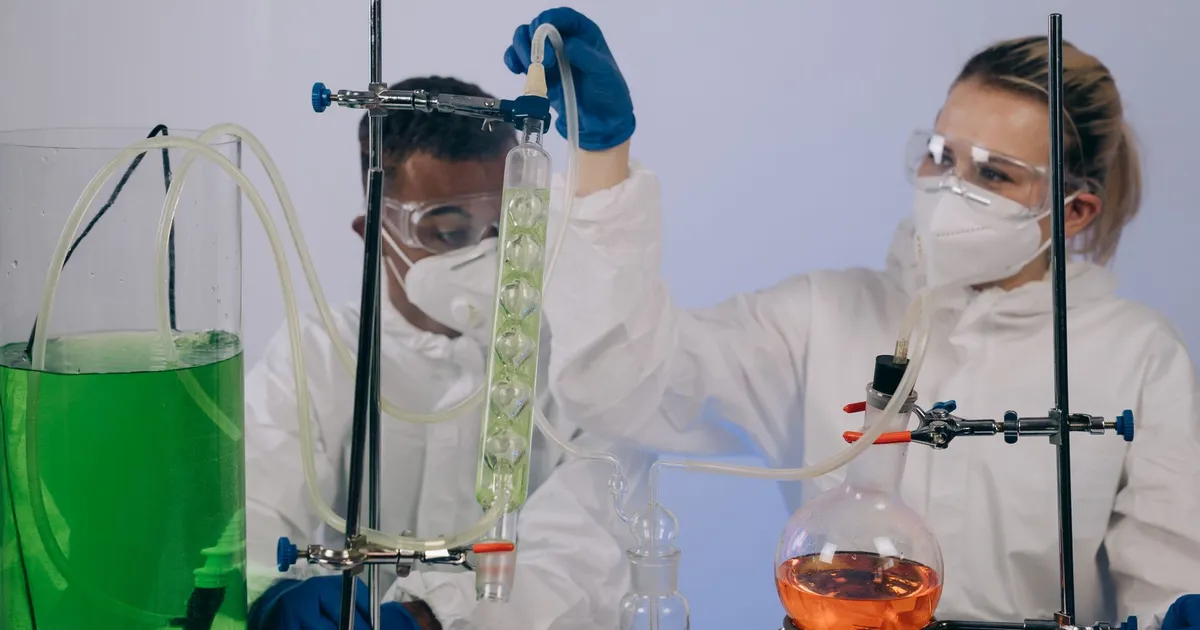

- Most peptide drugs are built one amino acid at a time on tiny resin beads, a method invented in 1963. Each added step is another chance for an error.
- The common impurities are near-copies of the peptide: missing or extra amino acids, mirror-image amino acids, or chemically altered ones.
- An HPLC purity of 99% describes the main peak on a chromatogram. It does not tell you how much of the powder is peptide, or whether it is sterile.
- Approved peptide drugs are held to impurity limits and tested for sterility. Research peptides usually are not.
Building a peptide one amino acid at a time
A peptide is a chain of amino acids. Most synthetic peptides are made by solid-phase peptide synthesis, invented by Bruce Merrifield in 1963: the first amino acid is anchored to a tiny resin bead, and each subsequent amino acid is added, one at a time, in a cycle of coupling and washing. A 2013 review notes that in the original method the purity of the final product fell as the number of coupling steps rose, a problem later reduced by better protecting groups (Boc and Fmoc) and other techniques (review) 1. At the end, the finished chain is cut from the bead, typically with trifluoroacetic acid, and purified 2.
Not every peptide drug is made this way. Some are produced by living cells: the Wegovy label says semaglutide's peptide backbone is produced by yeast fermentation and then chemically modified 3. Longer peptides and proteins such as growth hormone are made recombinantly. The method matters, because each route produces its own pattern of impurities.
Where impurities come from
Because synthesis happens step by step, the most common impurities are near-copies of the intended peptide. A 2025 analysis lists impurities arising from insertion, truncation, deamidation, isomerisation, oxidation and the manufacturing process itself (methods paper) 4. In plain terms: a chain missing an amino acid (a deletion or truncation), a chain with an extra one (an insertion), or a chain where an amino acid has been chemically altered, for example by oxidation or loss of an amide group.
A subtler problem is chirality. Amino acids come in mirror-image forms, and drugs use one form; racemisation during synthesis, or impure starting materials, can introduce the other (D-isomers), which can change how a peptide works (review) 5. These mirror-image impurities have the same mass as the intended peptide, so a simple mass check will not spot them.
Impurities matter for more than potency. A 2023 review explains that peptide drug impurities can introduce new sequences the immune system may react to, which is why FDA asks generic manufacturers to report any impurity not found in the original product (review) 6. Manufacturing scale and process also change a peptide's stability: a 2020 study of GLP-1 drugs found that synthetic and recombinant liraglutide from five suppliers each had distinct impurity profiles compared with the originator, and that trace metals increased the formation of large aggregates (laboratory study) 7.
Impurities after manufacture: storage and stress
Purity is not fixed at the factory. Peptides can break down after they are made, especially with heat and light. In a 2025 study, researchers exposed synthetic liraglutide to heat and light stress and identified ten impurities, including four degradation products not reported before, and mapped where on the chain the changes occurred (laboratory study) 8. The study's authors note that peptides are prone to degradation under improper storage or handling 8. This is why approved pens carry storage limits and why a certificate issued when a batch was made says little about a vial that has since spent days in a warm parcel. Our travel guide lists the labelled storage limits for approved pens.
Synthetic, fermented or recombinant: why the route matters
The same peptide can be made in different ways, and the route leaves its fingerprint. Liraglutide was first made recombinantly; FDA's 2021 guidance exists precisely because companies now make synthetic versions of liraglutide and four other peptides first made in cells, and it asks them to show that any impurity not found in the original is characterised, justified and no more than 0.5% 9. The 2020 GLP-1 study found that synthetic and recombinant liraglutide from five suppliers each had a distinct impurity profile from the originator, and concluded that follow-on versions should be clinically evaluated 7. Two products with the same name and the same main molecule are not necessarily the same product.
What '99% purity' actually measures
The purity figure on most certificates comes from high-performance liquid chromatography (HPLC) with a UV detector: the sample is separated into peaks, and purity is the main peak's share of the total peak area. That number is useful, but it is narrower than it sounds. Impurities do not all absorb UV light equally, so their peaks can over- or under-state how much is really there unless relative response factors are measured (methods paper) 4. Impurities that elute with the main peak can hide inside it.
More importantly, HPLC purity says nothing about what else is in the powder. A peptide powder also contains water, counter-ions and sometimes fillers. When Chinese metrologists assigned the true purity of a synthetic glucagon by measuring and subtracting every component, including water, TFA, inorganic ions and peptide impurities, they found 896 mg of glucagon per gram of sample, about 90% (mass-balance study) 10. A vial whose label says 10 mg of peptide, filled by weighing 10 mg of powder, would contain less than 10 mg of the peptide itself.
| What a certificate says | What it measures | What it can miss |
|---|---|---|
| HPLC purity, e.g. 99% | The share of UV-absorbing peptide material under the main peak | Water, salts (such as TFA), fillers, and impurities that absorb UV differently or hide under the main peak |
| Mass spectrometry identity | That a molecule of the right mass is present | How much is present; mirror-image (D-amino acid) versions with the same mass |
| Net peptide content | How much of the powder's weight is actually peptide | Often not reported at all on research certificates |
| Sterility and endotoxin | Microbes and bacterial toxins | Usually not tested for research peptides |
Salt forms: the TFA question
Because trifluoroacetic acid is used both to cut peptides from the resin and as an ion-pairing reagent during purification, synthetic peptides usually come out as TFA salts. A 2025 study notes that numerous studies highlight negative effects of TFA salts in biological assays, and showed TFA could be exchanged for chloride (laboratory study) 2. A research certificate rarely says which salt form is present or how much of the powder's weight it accounts for, which is one more reason a milligram of powder is not a milligram of peptide 10.
What purity tests can miss entirely
Some contaminants are invisible to standard UV-based HPLC. In 2019, researchers using NMR found that two custom synthetic peptides bought commercially contained 20% and 43% mannitol by weight, an undeclared sugar alcohol that does not absorb UV light and so did not show up in routine chromatography (analytical study) 11. A 'pure' peptide by HPLC can be substantially something else by weight.
Falsified products are worse. A Belgian study of the ten falsified peptide drugs most often found on that market, bought from suspected illegal internet pharmacies, found large variation in drug per unit, purities ranging from 5% to 75% for cysteine-containing peptides, and the toxic elements arsenic and lead, some at up to ten times the limit for injectable drugs (market surveillance) 12. A 2024 study of semaglutide bought online without a prescription found overdosed vials, and endotoxin in every one tested (test purchase) 13.
How regulators set limits for approved peptides
Approved peptide drugs are held to specifications. FDA's 2021 guidance on generic synthetic versions of five peptides first made recombinantly (glucagon, liraglutide, nesiritide, teriparatide and teduglutide) recommends that a generic contain no new peptide-related impurity above 0.5% of the drug substance, and that each new impurity be characterised and justified as not affecting safety or effectiveness 9. That is a far more detailed standard than a single purity percentage. Approved injectables are also manufactured under good manufacturing practice and tested for sterility.
Research peptides sit outside that system. Our guide to 'research use only' explains what that label does and does not promise, and our article on retatrutide testing shows what buyer-submitted certificates can and cannot reveal.
How to read a peptide certificate
Our COA Decoder walks through each line. In short: identity by mass spectrometry shows the right molecule is present but not how much or whether its amino acids are the right mirror form; HPLC purity describes the main peak, not the powder; net peptide content, when reported, tells you how much of the weight is peptide; and sterility and endotoxin results, which matter most for anything injected, are usually absent from research certificates. Our guide to spotting a fake COA covers forgeries.
Questions to ask about any peptide's quality
- Was it made under good manufacturing practice, as an approved product, or labelled for research?
- Does the certificate report net peptide content, salt form and water, or only HPLC purity?
- Was it tested for sterility and endotoxin?
- Is the certificate for this batch, and was the sample chosen by the seller?
The bottom line
Peptides are built step by step, and each step can leave flawed copies behind. A 99% HPLC purity measures the main peak, not the whole powder, and cannot see water, salts, fillers or microbes. Approved peptide drugs are held to impurity limits and sterility testing; research peptides usually are not, and studies of products bought online have found fillers, toxic metals and endotoxin. A purity number is a starting point, not a verdict.
Frequently asked questions
How are peptides made?
Most synthetic peptides are made by solid-phase peptide synthesis: amino acids are added one at a time to a chain anchored on a resin bead, then the chain is cut off and purified. Some, like semaglutide's backbone, are made by fermentation.
What does 99% purity mean for a peptide?
It usually means the main HPLC peak makes up 99% of the UV-detected peak area. It does not show how much of the powder is peptide, or whether water, salt, fillers or microbes are present.
What is a TFA salt?
Trifluoroacetic acid is used to cut peptides from the resin and to purify them, so synthetic peptides often end up as TFA salts. Studies report that TFA salts can affect biological assays, and the salt adds weight that is not peptide.
What impurities are found in peptides?
Mostly near-copies: chains missing or adding an amino acid, mirror-image amino acids, and chemically altered forms such as oxidised or deamidated ones.
Are research peptides tested for sterility?
Usually not. Research certificates typically report identity and HPLC purity; sterility and endotoxin, which matter most for injections, are rarely included.
Related on Grey Peptides
Sources
- Chandrudu, S., et al. (2013). Chemical methods for peptide and protein production. Molecules, 18(4), 4373-88. PMID: 23584057
- Erckes, V., et al. (2025). Towards a Consensus for the Analysis and Exchange of TFA as a Counterion in Synthetic Peptides and Its Influence on Membrane Permeation. Pharmaceuticals (Basel), 18(8). PMID: 40872554
- Novo Nordisk. WEGOVY (semaglutide) US prescribing information, section 11 (Description). DailyMed version 19, effective June 18, 2026; read October 3, 2026.
- Kumar Kuril, A. (2025). The Critical Need for Implementing RRF in the Accurate Assessment of Impurities in Peptide Therapeutics. Anal Chem, 97(24), 12480-12485. PMID: 40499007
- Badgujar, D., et al. (2024). Enantiomeric purity of synthetic therapeutic peptides: A review. Chirality, 36(3). PMID: 38448043
- De Groot, A. S., et al. (2023). Immunogenicity risk assessment of synthetic peptide drugs and their impurities. Drug Discov Today, 28(10), 103714. PMID: 37467878
- Staby, A., et al. (2020). Influence of Production Process and Scale on Quality of Polypeptide Drugs: a Case Study on GLP-1 Analogs. Pharm Res, 37(7), 120. PMID: 32514880
- Badgujar, D., et al. (2025). Assessment of Thermal and Photolytic Stress Effects on the Stability of Primary Structure of Synthetic Liraglutide Using LC-HRMS/MS. J Pept Sci, 31(9), e70050. PMID: 40814845
- U.S. Food and Drug Administration. ANDAs for Certain Highly Purified Synthetic Peptide Drug Products That Refer to Listed Drugs of rDNA Origin: Guidance for Industry. May 2021; read October 3, 2026. FDA
- Wang, X., et al. (2020). Purity determination of synthetic glucagon using a mass balance approach. Sci Rep, 10(1), 4423. PMID: 32157163
- Choules, M. P., et al. (2020). NMR reveals an undeclared constituent in custom synthetic peptides. J Pharm Biomed Anal, 178, 112915. PMID: 31671336
- Janvier, S., et al. (2018). Impurity profiling of the most frequently encountered falsified polypeptide drugs on the Belgian market. Talanta, 188, 795-807. PMID: 30029448
- Ashraf, A. R., et al. (2024). Multifactor Quality and Safety Analysis of Semaglutide Products Sold by Online Sellers Without a Prescription: Market Surveillance, Content Analysis, and Product Purchase Evaluation Study. J Med Internet Res, 26, e65440. PMID: 39509151
Educational information, not medical advice. Each dose in this guide names its source, an approved label or a published study. None is a recommendation for you. An unapproved compound has no established safe or effective human dose, and products sold for “research use only” are not made or tested for people. Talk to a doctor before acting on anything on this site, including before you start, stop or change any medicine or dose.
New guides and rule changes, by email
One short email when a peptide's legal status moves — an FDA or PCAC decision, a WADA list change, an enforcement action — plus new guides and tools. At most one a week, and none when nothing changes. The newsletter has not started sending yet: your first email will be its first issue.
We keep your email address and the page you signed up from, nothing else. How it works · Privacy · RSS instead