Tesamorelin: the approved GHRH analog and its visceral-fat evidence
Last updated: October 2, 2026 · 5 min read · By the Grey Peptides Editorial Board
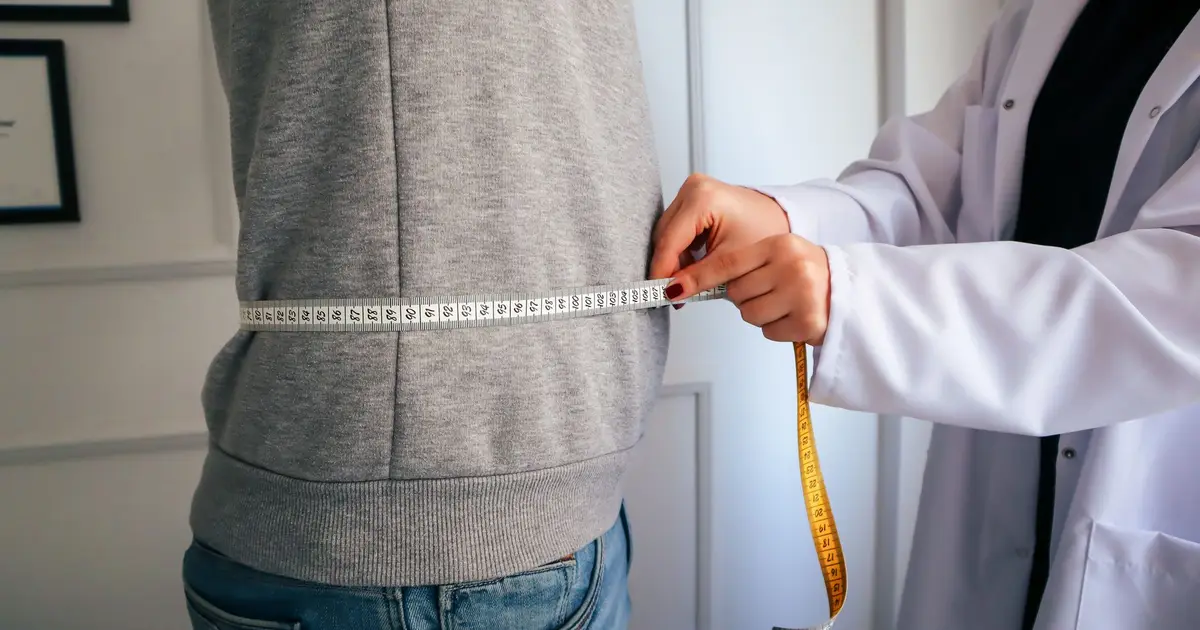

- Tesamorelin is the only approved drug that works like growth hormone-releasing hormone. Its approval, since 2010 in the US, is narrow: reducing excess abdominal fat in adults with HIV and lipodystrophy.
- In that use it shrinks visceral fat, the fat around the organs, by about 15% in six months, and it lowered liver fat in a year-long trial in people with HIV. The fat comes back when it is stopped.
- Its own label says it is not a weight-loss drug, because its effect on weight is neutral. It raises IGF-1, which the label says must be monitored, and it can worsen blood sugar.
What tesamorelin is
Tesamorelin High is an analogue of growth hormone-releasing hormone (GHRH): it makes the pituitary release more of the body's own growth hormone, which in turn raises IGF-1 1. It is sold by Theratechnologies as EGRIFTA SV, at 1.4 mg once daily, and EGRIFTA WR, at 1.28 mg once daily, both injected under the skin of the abdomen; the label stresses that the two formulations are not substitutable 1 2. It acts briefly: the mean elimination half-life was 11 minutes in healthy people 1. As of October 2, 2026 it is approved in the US; the EU application was withdrawn in 2012 2.
Its relatives are the gray-market GHRH analogues, sermorelin and CJC-1295. Sermorelin was once approved too, as Geref for children with growth hormone deficiency, but those products were discontinued; our ipamorelin vs sermorelin comparison covers it. Tesamorelin is the only member of the family with a current approval and modern phase 3 trials.
The trials behind the approval
The approval rests on two phase 3 trials in people with HIV on antiretroviral therapy who had excess abdominal fat. Pooled, they randomised 806 people 2:1 to tesamorelin 2 mg or placebo daily: at 26 weeks visceral fat fell by 24 cm² on the drug and rose by 2 cm² on placebo, a treatment effect of -15.4%, with no significant change in the fat under the skin 3. In the first trial's extension, people who stayed on tesamorelin kept an 18% reduction in visceral fat over 52 weeks, while those switched to placebo at week 26 regained it 4. A five-trial meta-analysis published in 2026 found reductions in visceral fat (about 28 cm²), trunk fat and liver fat and a gain of about 1.4 kg in lean mass, with no change in BMI 5.
The label draws the practical conclusion: consider whether to continue in people whose visceral fat has not fallen, and note that long-term cardiovascular safety has not been established 1.
Liver fat: the research beyond the label
The most promising work outside the approved use is in fatty liver disease, still in people with HIV. In a six-month trial of 50 people, tesamorelin reduced visceral fat by 34 cm² against an 8 cm² gain on placebo and lowered liver fat 6. A year-long trial in 61 people with HIV and a liver fat fraction of 5% or more found liver fat fell by 4.1 percentage points more on tesamorelin than placebo, a 37% relative reduction, and 35% of the treated group ended below the 5% threshold against 4% on placebo 7. Paired biopsies from that trial showed shifts in liver gene activity toward less inflammation and tissue repair 8, and a 2024 analysis found the effects held in participants on integrase-inhibitor HIV regimens, which are standard today 9.
None of this has been tested in large trials of people without HIV, and none of it is an approved use. It is the reason tesamorelin is discussed for MASH, the inflammatory form of fatty liver, not evidence that it treats it.
Is tesamorelin a weight-loss drug?
No, and its label says so directly: EGRIFTA WR is not indicated for weight-loss management because it has a weight-neutral effect 1. What it changes is where fat sits, reducing the visceral fat around the organs rather than overall weight, which matches the trial finding of no change in fat under the skin and no change in BMI 3 5. Outside HIV, a 12-week study in 53 people with type 2 diabetes was designed to check glucose safety rather than weight, and found no loss of diabetes control on 1 or 2 mg 10. In a phase 2 trial in people with HIV and cognitive impairment, waist size fell modestly but thinking did not improve 11.
IGF-1, blood sugar and the other warnings
Because tesamorelin works by raising growth hormone, its warnings follow from that. The label says to monitor IGF-1 during treatment and to consider stopping if it stays high, for example above 3 standard deviation scores, especially when the fat response is weak; in the trials, 47% of patients had IGF-1 above 2 SDS and 36% above 3 SDS at 26 weeks, as early as week 13 1. It warns of glucose intolerance: HbA1c reached 6.5% or more in 5% on the drug against 1% on placebo by week 26 1. Fluid retention, showing as swelling, joint pain or carpal tunnel syndrome, may occur 1. And it is contraindicated in active cancer, because growth hormone is a known growth factor, with careful evaluation advised for people with a history of cancer 1.
These are the reasons tesamorelin is a prescription drug with monitoring, and why taking a GHRH analogue bought online, without IGF-1 or glucose checks, removes the safeguards the approved product comes with.
Frequently asked questions
Does tesamorelin cause weight loss?
No. Its label says it is not indicated for weight loss because its effect on weight is neutral. It reduces visceral fat around the organs, by about 15% over six months in the HIV trials, without changing overall weight or BMI.
What is tesamorelin approved for?
Reducing excess abdominal fat in adults with HIV and lipodystrophy. It is sold as EGRIFTA SV (1.4 mg daily) and EGRIFTA WR (1.28 mg daily), first approved in the US in 2010.
What is the difference between tesamorelin and sermorelin?
Both are GHRH analogues that make the pituitary release growth hormone. Tesamorelin is currently approved and has modern phase 3 trials; sermorelin was approved as Geref for children with growth hormone deficiency, but those products were discontinued.
Why does tesamorelin need IGF-1 monitoring?
It raises growth hormone and IGF-1. In the trials 36% of patients had IGF-1 above 3 standard deviation scores at 26 weeks, and the label says to monitor it and consider stopping if it stays high.
Related on Grey Peptides
Sources
- Theratechnologies. EGRIFTA WR (tesamorelin) for injection US prescribing information (DailyMed set 839334d3-8c1d-4c26-9036-2ab524a6ea75, effective July 29, 2026); read October 2, 2026.
- Grey Peptides dataset, tesamorelin record (EGRIFTA SV and WR, first US approval 2010; EU application withdrawn June 2012); read October 2, 2026.
- Falutz, J., et al. (2010). Effects of tesamorelin (TH9507), a growth hormone-releasing factor analog, in human immunodeficiency virus-infected patients with excess abdominal fat: a pooled analysis of two multicenter, double-blind placebo-controlled phase 3 trials with safety extension data. J Clin Endocrinol Metab, 95(9), 4291-304. PMID: 20554713
- Falutz, J., et al. (2008). Long-term safety and effects of tesamorelin, a growth hormone-releasing factor analogue, in HIV patients with abdominal fat accumulation. AIDS, 22(14), 1719-28. PMID: 18690162
- Badran, A. S., et al. (2026). Body composition, hepatic fat, metabolic, and safety outcomes of Tesamorelin, a GHRH analogue, in HIV-associated lipodystrophy: A meta-analysis of randomized controlled trials. Obes Res Clin Pract, 20(1), 2-12. PMID: 41545261
- Stanley, T. L., et al. (2014). Effect of tesamorelin on visceral fat and liver fat in HIV-infected patients with abdominal fat accumulation: a randomized clinical trial. JAMA, 312(4), 380-9. PMID: 25038357
- Stanley, T. L., et al. (2019). Effects of tesamorelin on non-alcoholic fatty liver disease in HIV: a randomised, double-blind, multicentre trial. Lancet HIV, 6(12), e821-e830. PMID: 31611038
- Fourman, L. T., et al. (2020). Effects of tesamorelin on hepatic transcriptomic signatures in HIV-associated NAFLD. JCI Insight, 5(16). PMID: 32701508
- Russo, S. C., et al. (2024). Efficacy and safety of tesamorelin in people with HIV on integrase inhibitors. AIDS, 38(12), 1758-1764. PMID: 38905488
- Clemmons, D. R., et al. (2017). Safety and metabolic effects of tesamorelin, a growth hormone-releasing factor analogue, in patients with type 2 diabetes: A randomized, placebo-controlled trial. PLoS One, 12(6), e0179538. PMID: 28617838
- Ellis, R. J., et al. (2025). Effects of Tesamorelin on Neurocognitive Impairment in Persons With HIV and Abdominal Obesity. J Infect Dis, 231(5), 1230-1238. PMID: 39813152
Educational information, not medical advice. Each dose in this guide names its source, an approved label or a published study. None is a recommendation for you. An unapproved compound has no established safe or effective human dose, and products sold for “research use only” are not made or tested for people. Talk to a doctor before acting on anything on this site, including before you start, stop or change any medicine or dose.
New guides and rule changes, by email
One short email when a peptide's legal status moves — an FDA or PCAC decision, a WADA list change, an enforcement action — plus new guides and tools. At most one a week, and none when nothing changes. The newsletter has not started sending yet: your first email will be its first issue.
We keep your email address and the page you signed up from, nothing else. How it works · Privacy · RSS instead