Kits versus single vials: the price per milligram buyers are not shown
Last updated: October 28, 2026 · 12 min read · By the Grey Peptides Editorial Board
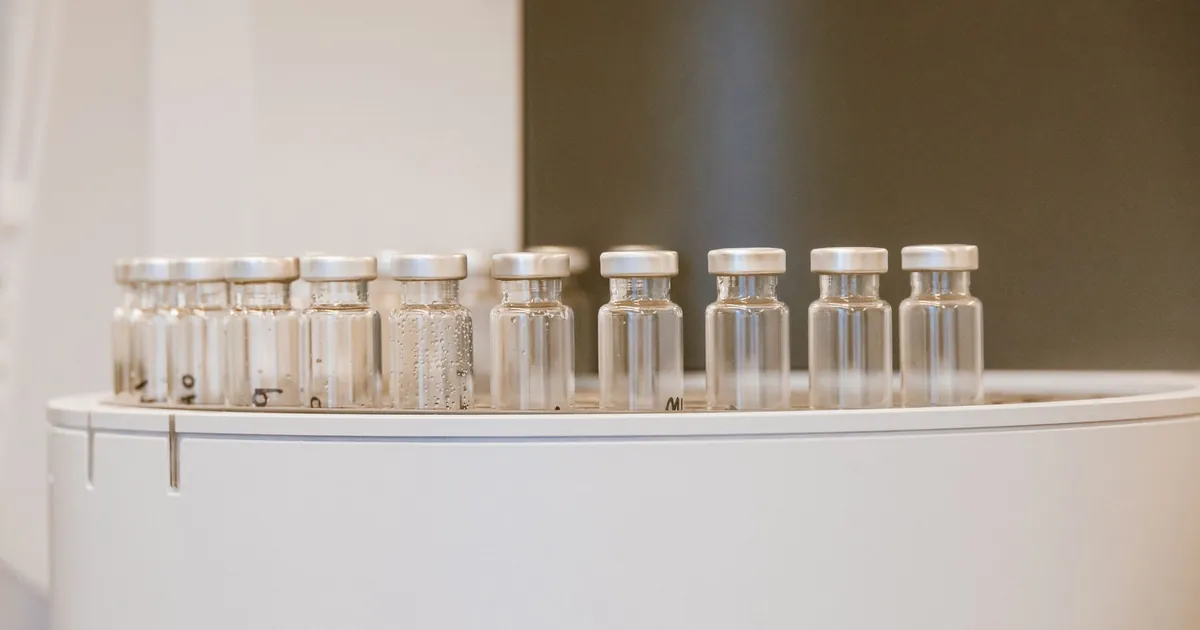

- A kit is a box of vials of one compound at one strength, sold as a unit. Ten vials is a common size and the one our examples use; we found no published survey of kit sizes.
- Compare offers by cost per milligram of the same compound, not by the price of a vial: price ÷ (vials × mg per vial).
- Worked example (October 2026), not a quote: $400 for one 15 mg vial is $26.67 per mg; $300 for ten 15 mg vials is $30 a vial and $2.00 per mg. One vial costs 13.3 times the kit's price per vial, and ten such vials would cost $4,000.
- A single vial still buys something: a smaller outlay, often faster domestic shipping, sometimes a test of that batch, and less to store. A kit buys ten vials from one batch, which is one risk taken ten times over.
- Only one vial needs to be mixed at a time. The bacteriostatic water label says to use a dissolved drug promptly, and 28 days is the outer limit for a manufacturer's opened vial, a sterility rule, not a keeping time 5,6.
- Before you buy ten of anything, ask what a failed batch would cost you: in the October 2026 example, the whole $300 kit.
What a kit is
On the grey market a kit is a box of several vials of the same compound at the same labelled strength, sold as one unit. A ten-vial box is common, and it is the size this page uses in its examples. We found no published survey of kit sizes, so treat ten as an example; the price-per-mg calculator takes any number of vials.
Kits are how much of this trade moves at its source. The New York Times reported in January 2026 that buyers were ordering kits directly from manufacturers in China for $50 to $100 each and paying extra to have them tested (news report; the article did not say which compound, strength or number of vials those prices were for) 1. That is the only dated public price for a kit we found that names no seller, and it is not a price for any particular product.
A single vial is one of those vials sold on its own. Some sellers list only single vials, some sell both, and nothing on a listing tells you where the vial was made or which box it came out of. One way a single-vial listing can exist is a reseller who buys a kit and sells its vials one at a time. That is a legitimate business model in many trades; the point of this page is only that the buyer should be able to see the arithmetic.
Three prices: per vial, per milligram and per dose
Every offer can be reduced to three numbers. You need the price, the number of vials and the labelled content of each vial in milligrams (mg). 1 mg is 1,000 micrograms (mcg).
- Cost per vial = price ÷ number of vials.
- Cost per mg = price ÷ (number of vials × mg per vial). This is the number that lets you compare a single vial with a kit, or a 10 mg vial with a 15 mg one.
- Cost per dose = cost per mg × the dose in mg, for what the vial contains. What you actually pay per dose is higher whenever a vial does not divide evenly into doses: the cost of the vial divided by the whole doses you can draw from it.
Per-dose and per-week costs depend on a dose, which this site never chooses for you. Where a compound has a sourced dose, its encyclopedia entry shows it in the Recommended dosing box with its source; the calculator lets you enter any amount, in mg or mcg, and does not ask which peptide it is.
The price per vial is the number that listings show and the number that misleads. In the worked example below (as of October 28, 2026), a $30 vial and a $400 vial look like two products; per milligram of the same compound at the same labelled strength they are the same product at two prices.
The resale arithmetic, worked
This is a worked example, not a price list, as of October 28, 2026. It uses one buyer's case as it was reported to our editors: about $400 paid for one 15 mg vial labelled retatrutide, when a ten-vial kit of 15 mg vials was selling for about $300. We have not verified either price, and we name neither seller. Change the numbers to your own and the arithmetic is the same.
| Offer A: one vial | Offer B: a ten-vial kit | |
|---|---|---|
| Price paid | $400 | $300 |
| Vials | 1 | 10 |
| Labelled content per vial | 15 mg | 15 mg |
| Total labelled content | 15 mg | 150 mg |
| Cost per vial | $400 ÷ 1 = $400 | $300 ÷ 10 = $30 |
| Cost per mg | $400 ÷ 15 = $26.67 | $300 ÷ 150 = $2.00 |
| Ten vials bought this way | 10 × $400 = $4,000 | $300 |
Step by step: the kit's cost per vial is $300 ÷ 10 = $30. The single vial costs $400 ÷ $30 = 13.3 times as much, so about a 13-fold markup on the kit's price per vial. Per milligram, the single vial is $400 ÷ 15 mg = $26.67 and the kit is $300 ÷ 150 mg = $2.00; the ratio is the same 13.3, because the vials are the same strength. Buying the kit's 150 mg one vial at a time at $400 would cost $4,000, which is $3,700 more than the kit.
The example is not unusual arithmetic: any time one vial costs more than a whole kit of the same strength, the single vial's price per milligram is more than ten times the kit's. A buyer who does not know kits exist cannot see this, and can pay several times more per milligram without any listing saying so.
Per dose. Retatrutide is approved nowhere, so no label gives a dose. Its phase 2 obesity trial gave fixed weekly doses in separate groups, among them 4 mg and 12 mg (Jastreboff 2023) 2. They are amounts a trial gave, not recommendations, and they are used here only to show how a vial divides. A 15 mg vial does not divide evenly into either:
| Trial arm (weekly) | Whole doses in a 15 mg vial | Left over | Offer A per dose | Offer B per dose |
|---|---|---|---|---|
| 4 mg arm 2 | 3 | 3 mg | $400 ÷ 3 = $133.33 | $30 ÷ 3 = $10.00 |
| 12 mg arm 2 | 1 | 3 mg | $400 ÷ 1 = $400.00 | $30 ÷ 1 = $30.00 |
By content alone, a 4 mg dose costs 4 × $26.67 = $106.67 from Offer A and 4 × $2.00 = $8.00 from Offer B (4 mg arm, Jastreboff 2023 2). Counting only whole doses, the 3 mg left in each vial raises both to $133.33 and $10.00. At one dose a week those are also the weekly costs, so the gap is about $123 a week in this example. The calculator does the same sums for any two offers.
Why single-vial sellers exist, and what a buyer gains or gives up
A single vial is not only a worse price. It solves real problems for some buyers, and a fair comparison counts them.
- A smaller outlay. One vial costs less money up front than a box of ten, even when each milligram costs far more. For someone who wants to try one compound once, that can matter more than the unit price.
- Less to store and less to waste. Ten vials are ten vials to keep cold and dry for months; one vial is used and gone (see the next section).
- Domestic stock and faster delivery. A seller holding vials in the US can usually ship within days, while an order from overseas takes longer and can be held at the border; our guide to peptide customs seizures explains how that works, with its sources.
- Sometimes, a test. Some resellers have a batch tested and show the report. A real, matching report for that batch is worth something, but only if it is real and matches: see how to spot a fake certificate of analysis.
What a buyer gives up is mainly money, as the worked example shows. A resold vial can also carry less information: a vial taken out of its box is a step further from the batch it came from, so ask which batch it is and whether the test you are shown is of that batch. Most buyers who pay a single-vial price never see a kit price at all, and that is the information gap this page is for.
What a kit means once it arrives: ten vials to store
A kit turns one purchase into months of supply. In the worked example, ten 15 mg vials at the 4 mg weekly trial arm (Jastreboff 2023 2) are 3 whole doses a vial, 30 doses in all: thirty weeks of weekly doses, most of them stored for months before use.
Unmixed and mixed vials are different problems. A vial sold as freeze-dried powder is dry for a reason: drying is how drug makers slow the chemical and physical breakdown that proteins and peptides undergo in solution 3. Once a vial is mixed, those processes run in water. Approved freeze-dried peptides show how short the allowance after mixing can be: EGRIFTA SV's label says to inject the dose at once and throw away the rest 4.
The diluent sets the limit too. The bacteriostatic water label says that when it is used to dissolve a drug, the solution should be used promptly and not stored unless the drug's own manufacturer directs otherwise 5. The 28 days often quoted is the outer limit for an opened multiple-dose vial from a manufacturer, a sterility rule from the Joint Commission, not a time any mixed peptide has been shown to keep 6. So with a kit, mix one vial at a time and leave the rest as powder. Our guides cover storing vials, bacteriostatic water and how long a mixed vial lasts.
For most research peptides we found no published stability data for the powder either, so the months a kit spends in a refrigerator are months of storage nobody has measured. A home refrigerator is not a pharmacy one: the CDC advises against keeping vaccines on door shelves, and a study of home refrigerators found insulin often kept outside its recommended range 7,8.
Ten vials from one untested batch
A kit is usually ten vials from one production run, so whatever is wrong with one is likely to be wrong with all ten. A single vial risks the price of one vial; a kit risks the price of the kit and months of supply.
The published tests show what the risk looks like. When researchers bought semaglutide from online sellers that required no prescription, the vials held 29% to 39% more than their labelled amount, and one vial measured 8.95 EU/mg of bacterial endotoxin 9. Endotoxin comes from bacteria, causes fever, and is not removed by the filters used to sterilise a solution 10. In Victoria, Australia, the health department reported cases of acute liver injury in people who had used products labelled retatrutide and said the toxic effects were possibly associated with a contaminant; the cause has not been established 11.
A purity test answers a narrower question than most buyers think: whether the labelled peptide is present and in what share of the sample. It says nothing about sterility or endotoxin unless those were tested too, and nothing about any batch other than the one sampled. Our lab results page lists published tests of these products, and the retatrutide testing failures guide shows what buyer-submitted tests found for this compound.
The arithmetic of a bad batch is simple. In the worked example (as of October 28, 2026), a failed kit loses $300 and ten vials; a failed single vial loses $400 and one. Even counting a failed kit as a total loss, the kit stays cheaper per usable milligram unless more than 92 of every 100 kits fail while every single vial is good ($2.00 ÷ (1 − 0.925) = $26.67 per mg). The real cost of a bad batch is not the money but what it does if you inject it.
How to compare two offers fairly
Put both offers on the same footing before you compare prices:
- Same compound and strength. Compare retatrutide with retatrutide; a lower price for a different molecule is not a saving. Listings use code names: our name decoder maps them to molecules.
- Cost per mg. Price ÷ (vials × mg per vial). Add shipping and any testing fee to the price first.
- Cost per dose you would actually use. Divide the vial's price by the whole doses it gives; leftover powder in each vial is paid for and not used.
- Testing. Is there a report, for this batch, from a laboratory, with a number that matches the vial? A report that does not match the batch is not a test of what you are buying.
- Shipping and time. Domestic stock usually arrives sooner; an overseas parcel can be detained at the border.
- The cost of a failed batch. Ten vials from one bad run is the kit's whole price; one vial is one vial's.
- Storage. Can you keep ten vials cold and dry for the months a kit lasts, and mix one at a time?
The price-per-mg calculator does steps 2 and 3 for two offers side by side and shows the difference per mg, per dose and per week. For the cost of a whole protocol, use the cost calculator; for what to look for in a seller, our guide to evaluating a vendor.
What this page is not
This page names no seller, links to none and recommends no source. Retatrutide, the compound in the worked example, has no approved version anywhere; FDA says it cannot be used in compounding under federal law and has warned companies that sold it directly to consumers labelled “for research purposes” 12. What “research use only” means legally is explained in our guide to the label. The arithmetic here applies to any compound sold by the vial, as of October 28, 2026.
Frequently asked questions
What is a peptide kit?
A box of several vials of the same compound at the same labelled strength, sold as one unit. Ten vials is a common size and the one our examples use; we found no published survey of kit sizes.
How do I work out the price per mg?
Divide the price by the total milligrams: price ÷ (number of vials × mg per vial). In our worked example (October 2026), $300 for ten 15 mg vials is $300 ÷ 150 = $2.00 per mg, and $400 for one 15 mg vial is $26.67 per mg.
Why is one vial sometimes more expensive than a whole kit?
A single vial can be one vial of a kit resold on its own, with the reseller's costs and margin added, sometimes with domestic shipping or a batch test. Nothing on a listing shows the kit price, so the only way to see the markup is to compare cost per mg of the same compound and strength.
Is a kit always the better deal?
Per milligram usually, but a kit is ten vials from one batch: if the batch is bad, all ten are. It also means months of storage, and only one vial should be mixed at a time. A single vial costs less up front and less to lose.
Does this page recommend any seller or price?
No. Every price on it is a labelled worked example or a dated news report that names no seller. Enter your own prices in the price-per-mg calculator.
Related on Grey Peptides
- Price-per-mg calculator: compare a vial with a kit
- Protocol cost calculator
- How to evaluate a peptide vendor
- Spot a fake COA in 60 seconds
- How to store peptides
- Bacteriostatic water guide
- Retatrutide testing failures
- Chinese peptides explained
Sources
- Sun, J. "'Chinese Peptides' Are the Latest Biohacking Trend in the Tech World." The New York Times, January 3, 2026 (syndicated text read October 4 and October 27, 2026): kits ordered directly from manufacturers in China for $50 to $100, with an extra fee to have them tested. A news report; cited without a link.
- Jastreboff, A. M. et al. (2023). Triple-Hormone-Receptor Agonist Retatrutide for Obesity - A Phase 2 Trial. New England Journal of Medicine, 389(6), 514-526. Separate groups received 1, 4, 8 or 12 mg once weekly for 48 weeks; read on PubMed October 28, 2026. PMID: 37366315 · doi:10.1056/NEJMoa2301972
- Manning, M. C. et al. (2010). Stability of protein pharmaceuticals: an update. Pharmaceutical Research, 27(4), 544-575. PMID: 20143256 · doi:10.1007/s11095-009-0045-6
- Theratechnologies Inc. EGRIFTA SV (tesamorelin) for injection, US prescribing information, section 2.2: reconstitute the lyophilized powder; administer immediately and throw away unused solution; do not freeze or refrigerate the reconstituted solution. DailyMed set 3d783378; read September 30, 2026. DailyMed
- Hospira, Inc. Bacteriostatic Water for Injection, USP, prescribing information: 0.9% (9 mg/mL) or 1.1% (11 mg/mL) benzyl alcohol as a bacteriostatic preservative; multiple-dose container; when diluting or dissolving drugs, mix thoroughly and use promptly, and do not store reconstituted solutions of drugs for injection unless otherwise directed by the manufacturer of the solute. DailyMed set 87d6e9dc, version 20; storage wording re-read October 27, 2026. DailyMed
- The Joint Commission. Multi-dose vials: managing multi-dose vials of injectable medication (standards FAQ): an opened or accessed multiple-dose vial from a manufacturer is dated and discarded within 28 days unless the manufacturer specifies a different date. Read September 30, 2026. Joint Commission
- Centers for Disease Control and Prevention. Vaccine Storage and Handling Toolkit, July 2026 (updated July 14, 2026), Section Three: avoid storing vaccines directly under cooling vents, in deli, fruit or vegetable drawers, or on refrigerator door shelves. Read October 28, 2026. CDC (PDF)
- Braune, K. et al. (2019). Storage Conditions of Insulin in Domestic Refrigerators and When Carried by Patients: Often Outside Recommended Temperature Range. Diabetes Technology and Therapeutics, 21(5), 238-244. PMID: 31009254 · doi:10.1089/dia.2019.0046
- Ashraf, A. R. et al. (2024). Multifactor Quality and Safety Analysis of Semaglutide Products Sold by Online Sellers Without a Prescription: Market Surveillance, Content Analysis, and Product Purchase Evaluation Study. Journal of Medical Internet Research, 26, e65440. PMID: 39509151 · doi:10.2196/65440
- FDA. Inspection Technical Guide: Bacterial Endotoxins/Pyrogens (endotoxin is lipopolysaccharide from the outer membrane of gram-negative bacteria; not removed by sterilizing or microbiological filters; fever its most emphasized effect). Content current as of November 17, 2014; read October 27, 2026. FDA
- Victorian Department of Health. Health alert: Toxicity linked to unapproved peptide product labelled Retatrutide. Issued June 19, 2026 by the Chief Health Officer (page updated June 19, 2026); re-read October 27, 2026.
- U.S. Food and Drug Administration. FDA's Concerns with Unapproved GLP-1 Drugs Used for Weight Loss (sections on retatrutide and cagrilintide, products sold 'for research purposes', FDA actions and reporting). Content current as of October 1, 2026; re-read October 27, 2026. FDA
Educational information, not medical or purchasing advice. Every price on this page is a labelled worked example or a dated news report, and no seller is named or linked. Dose amounts are those a named trial gave, cited where they appear, and are not recommendations. Retatrutide is not approved anywhere; see a doctor before starting, stopping or changing any medicine.
New guides and rule changes, by email
One short email when a peptide's legal status moves — an FDA or PCAC decision, a WADA list change, an enforcement action — plus new guides and tools. At most one a week, and none when nothing changes. The newsletter has not started sending yet: your first email will be its first issue.
We keep your email address and the page you signed up from, nothing else. How it works · Privacy · RSS instead