Copper peptides with vitamin C, retinol or acids: what the chemistry says
Last updated: October 3, 2026 · 6 min read · By the Grey Peptides Editorial Board
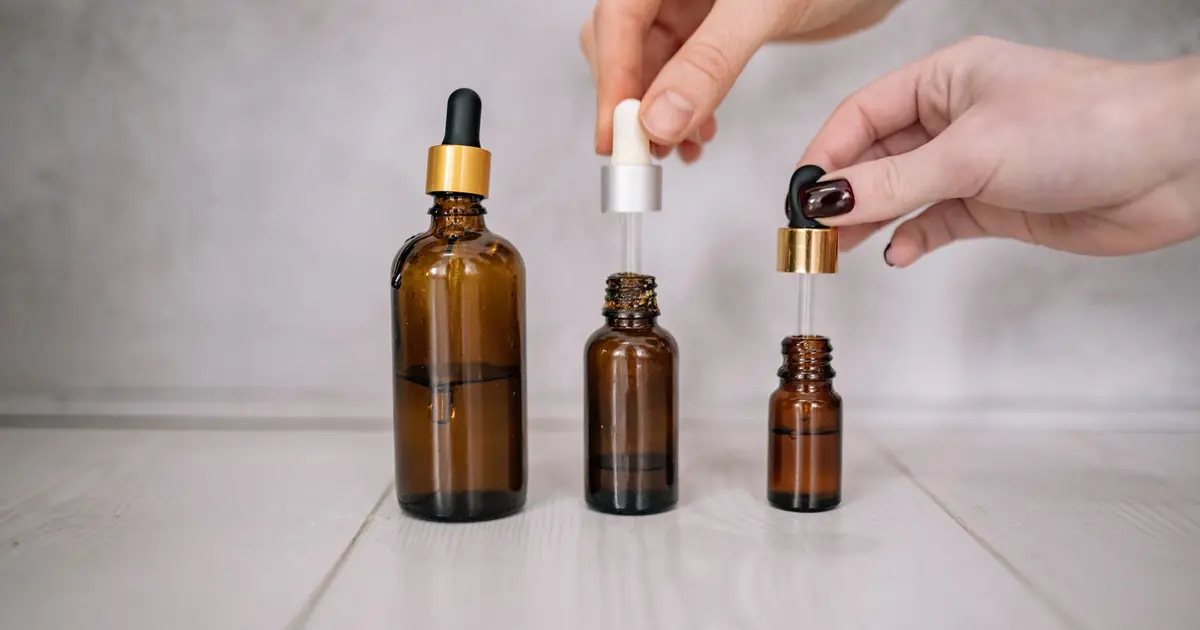

- No clinical study has tested copper peptides together with vitamin C, retinol or hydroxy acids on skin, so every rule you read about combining them is an inference, not a finding.
- The vitamin C worry has a real chemical basis: copper speeds up the oxidation of ascorbic acid in solution, and the best-studied vitamin C serums are strongly acidic, outside the range in which GHK-Cu's stability was tested.
- For retinoids and acids the evidence is thinner still. Using them at different times of day is a reasonable precaution against irritation and instability, but nobody has shown that mixing them causes harm or that separating them helps.
Where the rule comes from
GHK-Cu Low, listed on ingredient labels as copper tripeptide-1, is the copper peptide in most serums. Skincare guides routinely say it should not be used with vitamin C, retinol or exfoliating acids. That advice is repeated so often that it reads like settled science. It is not. We searched PubMed for studies testing GHK-Cu with each of these ingredients on human skin and found none. What exists is chemistry done in test tubes and formulation labs, plus general reviews of how the other ingredients behave. This article sets out what that evidence shows, so the advice can be weighed for what it is.
It also helps to be clear about what a copper peptide is in a jar. A 2026 review of GHK-Cu's formulation science stresses that the label hides a lot: the same name covers the peptide with copper firmly bound, the peptide without copper, related copper complexes, and loosely held copper that can come free, and studies rarely measure which of these is actually present 1. Any interaction depends on that state, which is one reason simple rules are hard to justify.
Vitamin C: the strongest case for caution
Vitamin C as L-ascorbic acid is unstable. A review of topical vitamin C describes how that instability has driven the development of derivatives and stabilisation strategies, and notes that efficacy data in people remain limited, especially for the derivatives 2. A 2026 systematic review found that L-ascorbic acid remains the most clinically validated form, with the best results from low-pH stabilised formulations, often combined with vitamin E and ferulic acid 3.
Copper matters because it accelerates the breakdown of ascorbic acid. In aerated solution at pH 4.5, copper(II) ions catalysed the oxidation of ascorbic acid, following first-order kinetics 4. A study of copper bound to histidine-containing peptides, the same kind of binding site GHK uses, found that the effect depends on how the copper is held: loosely bound copper in clusters of histidines roughly doubled the rate of ascorbic acid oxidation compared with free copper, while copper held tightly in a particular peptide pocket inhibited it 5. GHK was not one of the peptides tested, so the study does not say which way GHK-Cu goes. It does show that the outcome depends on the copper's binding state, which, as the 2026 review notes, is rarely measured in cosmetics 1 5.
The pH also matters from the other direction. In a preformulation study, GHK-Cu degraded under oxidative and basic stress and, to a lesser extent, under acidic stress, but it was stable in water and in buffers between pH 4.5 and 7.4 for at least two weeks at 60 °C 6. The most effective vitamin C serums are formulated at low pH 3, below the range in which GHK-Cu was shown to be stable. So the concern is plausible on two counts: copper can speed the loss of vitamin C, and a strongly acidic vitamin C serum puts GHK-Cu outside the conditions in which its stability was tested. What has not been shown is that applying the two to skin, minutes apart, changes the results of either.
Retinol and tretinoin: little more than theory
The only study we found that put copper tripeptide and a retinoid into the same experiment tested them separately. In fibroblasts grown from facial skin, tretinoin increased one growth factor in normal cells, while copper tripeptide reduced a scarring-related growth factor in cells from keloid scars 7. The two were never combined, and the work was in cells, not skin.
The usual reason given for separating retinoids from copper peptides is irritation: both are active ingredients, and stacking actives can make skin red and sore. A 2026 review of topical vitamins notes that they are usually well tolerated but that irritation and burning can be troublesome, and that formulation and stability are major limitations 8. That is a reasonable basis for introducing one product at a time and watching how the skin responds. It is not evidence that copper peptides and retinoids inactivate each other, and we found no study showing that they do.
Hydroxy acids: a pH question
Exfoliating acids such as glycolic and lactic acid work at low pH. We found no study testing GHK-Cu alongside them. The only relevant data are the stability results above: GHK-Cu degraded to some extent under acidic stress and was shown to be stable down to pH 4.5 6. Whether a brief exposure on skin, after an acid toner, matters in practice is unknown. The more concrete risk is irritation from combining an exfoliant with other actives on the same skin, which is the same precaution as for retinoids 8.
A sensible approach, labelled as such
Given that evidence, a cautious routine looks like this, with the reasons spelled out so they can be judged. Using a low-pH L-ascorbic acid serum and a copper peptide at different times of day, for example vitamin C in the morning and the copper peptide at night, avoids putting the two chemistries together on the skin at once; the reason is the copper-ascorbate chemistry and the pH mismatch, not a clinical finding 4 6. Introducing one active at a time, especially a retinoid or an acid, makes it easier to tell which product causes irritation 8. And treating any product that combines copper peptides and vitamin C in one bottle with some scepticism is reasonable unless its maker publishes stability data, because the binding state of the copper and the pH decide whether the vitamin C survives 1 5.
None of this is a reason to expect a copper peptide to do much on its own. As our guide to copper peptides for skin explains, the human trials with measured outcomes are few and mostly small. Getting the combinations right will not turn a weak ingredient into a strong one.
What would settle it
Three kinds of study would answer the question properly. First, stability testing of real products: how much vitamin C and how much intact GHK-Cu remain after weeks when the two share a formulation, measured with the speciation methods the 2026 review calls for 1. Second, skin studies that apply the products in sequence and measure what survives on and in the skin. Third, clinical comparisons of routines that combine and separate them, with irritation and visible outcomes recorded. Until then, the honest summary is that the caution about vitamin C is chemically plausible, the caution about retinoids and acids is mostly about irritation, and none of it has been tested where it matters.
Frequently asked questions
Can you use copper peptides with vitamin C?
No study has tested the combination on skin. Copper speeds up the breakdown of ascorbic acid in solution, and effective vitamin C serums are strongly acidic, so using them at different times of day is a reasonable precaution rather than an evidence-based rule.
Can you use copper peptides with retinol?
No study shows that they cancel each other out. The main reason to separate them is that stacking active ingredients can irritate skin, so introduce one at a time.
Can you use copper peptides after an AHA or BHA?
There is no direct study. GHK-Cu was shown to be stable down to pH 4.5, and stacking an exfoliant with other actives can cause irritation, so many people use them at different times.
Do products that combine copper peptides and vitamin C work?
Only stability data from the maker can show whether both ingredients survive in the same bottle; how the copper is bound and the formula's pH decide that.
Related on Grey Peptides
Sources
- Mateescu, D. M., et al. (2026). GHK-Cu as a Bioactive Metallopeptide and Drug-Delivery Cargo: Coordination Chemistry, Formulation Science, Therapeutic Evidence, and a Translational Roadmap. Pharmaceutics, 18(9). PMID: 42797253
- Vasques, L. I., et al. (2023). Topical Application of Ascorbic Acid and its Derivatives: A Review Considering Clinical Trials. Curr Med Chem, 30(29), 3272-3286. PMID: 36200216
- Boghosian, T., et al. (2026). Clinical Applications of Vitamin C in Dermatology: A Systematic Review. J Clin Aesthet Dermatol, 19(7), 10-15. PMID: 42761976
- Beker, B. Y., et al. (2011). Protection of ascorbic acid from copper(II)-catalyzed oxidative degradation in the presence of flavonoids: quercetin, catechin and morin. Int J Food Sci Nutr, 62(5), 504-12. PMID: 21391791
- Ueda, J. I., et al. (2000). Autoxidation of ascorbic acid catalyzed by the copper(II) bound to L-histidine oligopeptides, (His)iGly and acetyl-(His)i Gly (i=9, 19, 29). Relationship between catalytic activity and coordination mode. Chem Pharm Bull (Tokyo), 48(7), 908-13. PMID: 10923816
- Badenhorst, T., et al. (2016). Physicochemical characterization of native glycyl-l-histidyl-l-lysine tripeptide for wound healing and anti-aging: a preformulation study for dermal delivery. Pharm Dev Technol, 21(2), 152-60. PMID: 25384620
- McCormack, M. C., et al. (2001). The effect of copper tripeptide and tretinoin on growth factor production in a serum-free fibroblast model. Arch Facial Plast Surg, 3(1), 28-32. PMID: 11176716
- Mukhopadhyay, P., et al. (2026). Topical vitamins: Uses and limitations-part I. Clin Dermatol, 44(3), 415-425. PMID: 41956404
Educational information, not medical advice. Each dose in this guide names its source, an approved label or a published study. None is a recommendation for you. An unapproved compound has no established safe or effective human dose, and products sold for “research use only” are not made or tested for people. Talk to a doctor before acting on anything on this site, including before you start, stop or change any medicine or dose.
New guides and rule changes, by email
One short email when a peptide's legal status moves — an FDA or PCAC decision, a WADA list change, an enforcement action — plus new guides and tools. At most one a week, and none when nothing changes. The newsletter has not started sending yet: your first email will be its first issue.
We keep your email address and the page you signed up from, nothing else. How it works · Privacy · RSS instead