How many peptides at once? The case against mega-stacks
Last updated: October 3, 2026 · 8 min read · By the Grey Peptides Editorial Board
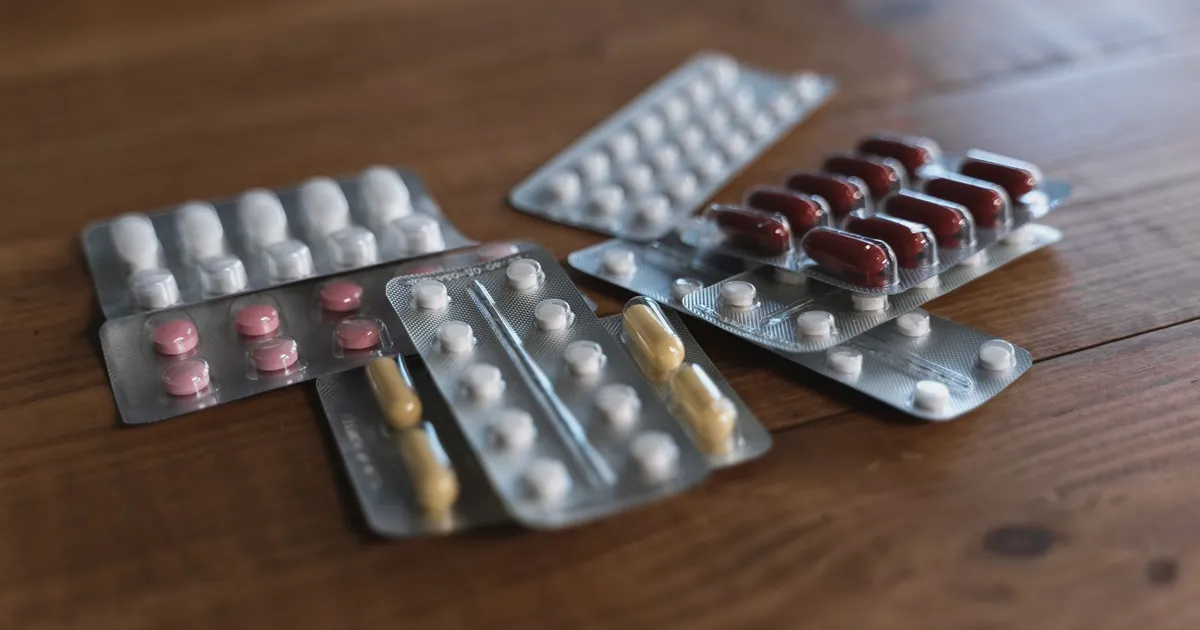

- Every peptide added to a stack multiplies the possible interactions: five peptides make 10 pairs, eight make 28.
- Most peptides have little or no interaction data. In our encyclopedia, only 34 of 348 have interactions that are fully studied or studied.
- When something goes wrong on a stack, there is no way to tell which compound caused it.
- Each vial carries its own quality risk, so a stack of research peptides multiplies the chance of a bad product.
Why stacks are popular, and why that is a problem
Stacking, taking several peptides together, is everywhere in online protocols: healing stacks of BPC-157, TB-500 and GHK-Cu; growth hormone stacks of CJC-1295 and ipamorelin; 'longevity' stacks of five or more compounds. The logic offered is that each peptide does something different, so combining them should do more. Our blends and stacks hub examines ten common combinations one by one, and none of them has been tested as a combination in a published human trial 1.
This article makes the general case: why each extra compound adds risk faster than it adds plausible benefit.
The arithmetic of interactions
Interactions happen between pairs. A stack of n compounds contains n(n−1)/2 pairs, so the number grows much faster than the number of compounds. Two peptides make one pair; five make ten; eight make 28; ten make 45.
| Peptides in a stack | Pairs to consider |
|---|---|
| 2 | 1 |
| 3 | 3 |
| 4 | 6 |
| 5 | 10 |
| 6 | 15 |
| 8 | 28 |
| 10 | 45 |
That is before counting the medicines, supplements and alcohol people already take, each of which adds more pairs. Real-world evidence shows how this plays out with prescribed drugs. In a study of more than 600,000 elderly patients in Sweden's prescribed drug register, the probability of potential drug-drug interactions rose strongly with the number of drugs dispensed, and even more strongly for potentially serious interactions (registry study) 2. Those were approved medicines with well-documented interaction profiles. Research peptides mostly have none.
How little is known about peptide interactions
Our encyclopedia records, for each of its 348 peptides, how much interaction evidence exists. As of October 3, 2026, only 4 have full coverage and 30 have interactions studied in the literature; 57 rely on interaction information from a drug label and 57 are partial; 109 have no interactions found in the literature, and 91 are not yet reviewed 3. 'None found' means no published interaction studies, not that interactions do not exist. For most research peptides, the interaction data that would make stacking predictable simply have not been gathered.
Our Stack Analyzer shows what is known for up to six compounds: documented interactions, overlapping effects, sport status and evidence grades. Its most common output for research-peptide stacks is not a warning but a gap: a blank where interaction evidence should be, which should be read as 'unknown', never as 'safe'.
When something goes wrong, which one was it?
The second problem is attribution. If a single peptide causes a rash, nausea, a blood pressure change or a blood sugar swing, it can be stopped and the effect watched. On a stack of five injected together, there is no way to know which compound, which pair, or which contaminant was responsible, and stopping everything loses whatever was helping. Our blend pages make this point for each combination: a combined injection makes any reaction impossible to attribute 1.
The same problem spoils any benefit. If someone feels better on a stack, they cannot tell which component mattered, so they keep taking all of them, with all the risks, indefinitely.
Overlapping effects add up
Some stacks combine compounds that act on the same system, which doubles the effect and the side effects rather than combining different benefits. Melanotan II and PT-141 both act on melanocortin receptors, so taking both stacks nausea, blood pressure changes and skin darkening 1. The Wegovy label advises against combining semaglutide with other semaglutide products or other GLP-1 drugs 4, yet 'GLP stacks' that combine them circulate online. Several growth-hormone-raising compounds affect blood sugar, which our blood sugar guide explains, and stacking them compounds that effect.
The interactions we do know about are real
Where peptides have been studied properly, as approved drugs, their labels show that interactions are not hypothetical. The Wegovy and Zepbound labels say both drugs delay gastric emptying and can therefore affect the absorption of other medicines taken by mouth, and both advise considering lower doses of insulin or insulin-releasing drugs to reduce the risk of low blood sugar 4 5. Both labels also warn that delayed gastric emptying has been linked to rare reports of inhaling stomach contents during anaesthesia or deep sedation 4 5. The Vyleesi label says bremelanotide may slow gastric emptying, and that it can significantly reduce the levels of oral naltrexone, a medicine for alcohol or opioid dependence, so the two should not be combined 6.
Those effects were found because each drug went through formal interaction studies before approval. Research peptides, including several that act on the same systems, have had no such studies, so the interactions that exist among them are simply unknown rather than absent 3.
Stacks and medical procedures
The anaesthesia warning on GLP-1 labels shows another hidden cost of stacking: clinicians need to know everything a person takes before surgery or sedation 4. Someone on a mega-stack of research peptides may not remember every component, may not know what each does, and may have products whose real contents differ from their labels 7. That leaves an anaesthetist or emergency doctor unable to judge risks that would be routine for a known medicine list.
Premixed blends make it worse
Premixed multi-peptide vials, increasingly common online, add a further problem: the ratio is fixed by the seller, so one component cannot be stopped or changed without stopping all of them. Our Blend Calculator shows what each draw delivers of every component, and our blend pages explain that equal milligrams of different peptides are not equal effects, because potencies differ enormously 1. A blend vial turns a stack into a single, unadjustable product.
Every vial is its own risk
Research peptides are not made to medicine standards, and each vial carries its own chance of being wrong. Vials sold online as 10 mg of melanotan II contained 4.32 to 8.84 mg, some with unknown impurities (laboratory analysis) 7. Semaglutide bought online without a prescription was found overdosed, with endotoxin in every vial tested (test purchase) 8. A stack of five research peptides is five independent chances of a mislabelled, under-filled or contaminated product. Our guide to how peptides are made explains why, and our injection reactions guide covers what contamination can do.
More compounds, more injections
Stacks are often injected separately, which multiplies needle sticks. Repeated injection into the same areas has measurable consequences: lipohypertrophy, lumps of thickened fat at injection sites that can affect how medicines are absorbed, affected 42% of insulin users in a 2021 meta-analysis, with incorrect site rotation the strongest risk factor (meta-analysis) 9. Each additional injection is also another chance of contamination. Our injection reactions guide covers site rotation and the signs of infection.
What medicine learned about 'more drugs'
Medicine has spent decades learning that more drugs mean more harm. The authors of the Swedish register study concluded that the strong link between the number of drugs and potentially serious interactions shows the importance of minimising the number of drugs where possible (registry study) 2. Deprescribing, the deliberate stopping of medicines that are no longer needed, is now tested in randomised trials: in a 2026 cluster-randomised trial, pharmacists trained in deprescribing-focused medication reviews worked with 318 patients aged 75 and over with hyperpolypharmacy, the use of a very large number of medicines, measuring how many could be reduced or stopped (randomised trial) 10. The online stacking culture runs in the opposite direction, adding compounds whose interactions have never been studied to compounds whose effects in people are often unknown 3.
What happens when stacking goes badly
The most detailed warnings come from performance-enhancing drug users, who stack routinely. A 2013 report in the Journal of Clinical Endocrinology and Metabolism described a previously healthy recreational weightlifter using multiple performance-enhancing substances, stimulants and masking agents who developed jaundice and hepatitis that progressed rapidly to liver and multi-organ failure, and reviewed how stacking adds the risk of toxic contaminants to each drug's own risks (case report and review) 11. Peptide stacks are not anabolic steroid stacks, but the principle the authors drew applies: combining many unregulated substances creates risks no single one carries.
If someone stacks anyway
This site does not recommend any stack. For anyone who is going to combine compounds regardless, the pharmacology points to a few principles. Fewer is safer, given how pairs multiply. Starting compounds one at a time, rather than all at once, is the only way to attribute a reaction. Duplicating a mechanism, such as two GLP-1 drugs or two melanocortin agonists, stacks side effects 4 1. And telling a doctor everything taken, including research products, is what lets them check for the interactions that are known; our guide to talking to your doctor includes a script.
Sport
For tested athletes, a stack is only as clean as its most prohibited component; many common stack ingredients, including growth hormone secretagogues and BPC-157, are prohibited 3. Our WADA hub lists each peptide.
Questions to ask about any stack
- Has this combination ever been tested in people? For research-peptide stacks, the answer is almost always no.
- Do any two components act on the same system?
- How many pairs, including my other medicines, does this create?
- If I have a reaction, how will I know which compound caused it?
- What is the quality evidence for each vial separately?
The bottom line
Mega-stacks multiply interaction pairs, overlap effects, make side effects impossible to attribute and multiply quality risks, while the interaction data for most research peptides do not exist. Approved medicines show that interaction risk climbs steeply with the number of drugs. No multi-peptide stack has been tested as a combination in people. If anything is combined at all, fewer compounds, introduced one at a time and disclosed to a doctor, is the evidence-based direction.
Frequently asked questions
How many peptides can you take at once?
There is no tested safe number for research peptides. Each added compound multiplies possible interaction pairs, five peptides make 10 pairs, and most peptides have little interaction data.
What are the side effects of peptide stacks?
Stacks combine each compound's side effects, add unknown interactions, and stack overlapping effects such as nausea or blood sugar changes; when a reaction happens, its cause cannot be identified.
Is it safe to stack BPC-157 and TB-500?
No study has tested the combination in people. Our blend page explains what is known about each and why the pair is untested.
Why do people stack peptides?
Online protocols claim each peptide does something different, so combining them should do more. That has not been tested for the popular stacks.
Does the Stack Analyzer approve stacks?
No. It shows known interactions, overlapping effects, sport status and evidence for up to six compounds, and highlights where data are missing.
Related on Grey Peptides
Sources
- Grey Peptides blend pages (ten compositions, including BPC-157/TB-500, CJC-1295/ipamorelin, melanotan II/PT-141), each noting no published human trial of the combination. Read October 3, 2026.
- Johnell, K., et al. (2007). The relationship between number of drugs and potential drug-drug interactions in the elderly: a study of over 600,000 elderly patients from the Swedish Prescribed Drug Register. Drug Saf, 30(10), 911-8. PMID: 17867728
- Grey Peptides encyclopedia dataset (assets/peptides-data.json), interactionCoverage field across 348 entries, and WADA status fields. Computed October 3, 2026.
- Novo Nordisk. WEGOVY (semaglutide) US prescribing information, Limitations of Use. DailyMed version 19, effective June 18, 2026; read October 3, 2026.
- Eli Lilly. ZEPBOUND (tirzepatide) US prescribing information, Warnings 5.9 and Drug Interactions 7.1-7.2. DailyMed version 40, effective August 28, 2026; read October 3, 2026.
- VYLEESI (bremelanotide injection) US prescribing information, Drug Interactions 7.1-7.2. DailyMed version 1, effective November 13, 2025; read October 3, 2026.
- Breindahl, T., et al. (2015). Identification and characterization by LC-UV-MS/MS of melanotan II skin-tanning products sold illegally on the Internet. Drug Test Anal, 7(2), 164-72. PMID: 24771717
- Ashraf, A. R., et al. (2024). Multifactor Quality and Safety Analysis of Semaglutide Products Sold by Online Sellers Without a Prescription: Market Surveillance, Content Analysis, and Product Purchase Evaluation Study. J Med Internet Res, 26, e65440. PMID: 39509151
- Wang, K., et al. (2021). A meta-analysis and meta-regression on the prevalence of lipohypertrophy in diabetic patients on insulin therapy. Therapie, 76(6), 617-628. PMID: 33958198
- Baas, G., et al. (2026). Deprescribing in older patients with hyperpolypharmacy: a cluster-randomised trial in primary care. Age Ageing, 55(7). PMID: 42472621
- Perera, N. J., et al. (2013). The adverse health consequences of the use of multiple performance-enhancing substances--a deadly cocktail. J Clin Endocrinol Metab, 98(12), 4613-8. PMID: 24217902
Educational information, not medical advice. Each dose in this guide names its source, an approved label or a published study. None is a recommendation for you. An unapproved compound has no established safe or effective human dose, and products sold for “research use only” are not made or tested for people. Talk to a doctor before acting on anything on this site, including before you start, stop or change any medicine or dose.
New guides and rule changes, by email
One short email when a peptide's legal status moves — an FDA or PCAC decision, a WADA list change, an enforcement action — plus new guides and tools. At most one a week, and none when nothing changes. The newsletter has not started sending yet: your first email will be its first issue.
We keep your email address and the page you signed up from, nothing else. How it works · Privacy · RSS instead