What makes a peptide a peptide?
Last updated: October 3, 2026 · 9 min read · By the Grey Peptides Editorial Board
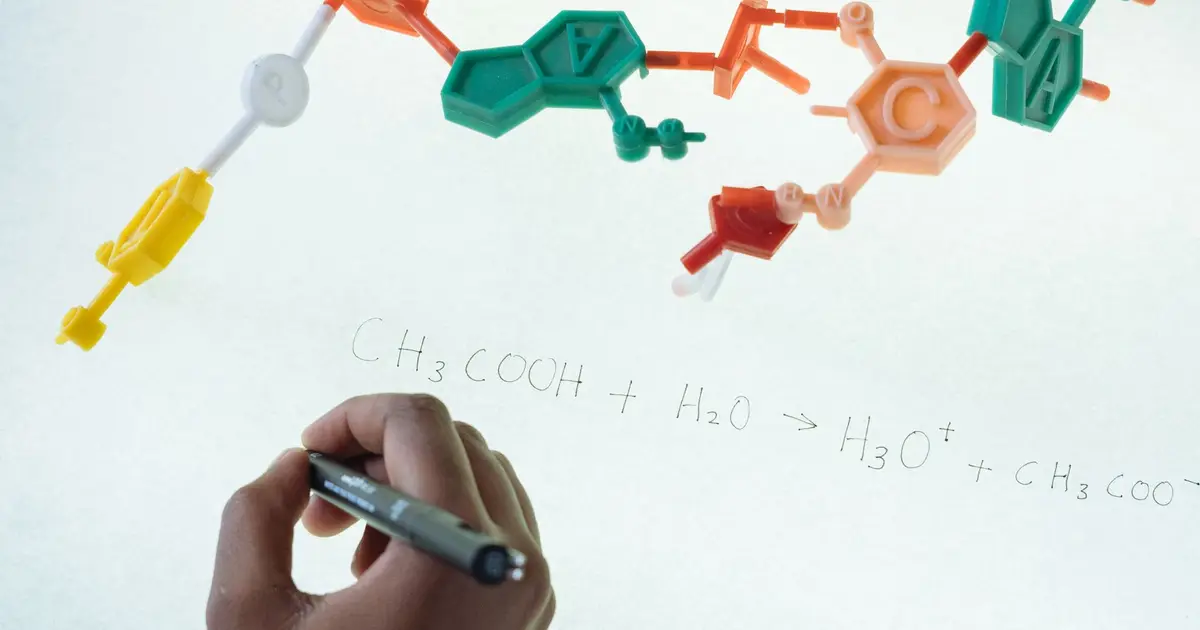

- A peptide is a chain of amino acids joined by peptide bonds. FDA's regulations call a chain of more than 40 amino acids a protein, and treat 40 or fewer as a peptide: semaglutide, at 31, is a peptide; somatropin, at 191, is a protein.
- Several compounds sold as peptides are not. MK-677 and orforglipron are small molecules that act on the same receptors as peptides; NAD+ is a coenzyme. 16 of our 348 entries are small molecules.
- The label matters because it changes how a compound is made, tested, regulated and absorbed. 'Peptide' on a vial is a marketing word until the chemistry backs it up.
The chemistry: amino acids and peptide bonds
Amino acids are small molecules with an amino group at one end and a carboxyl group at the other. When the carboxyl group of one joins the amino group of the next, losing a molecule of water, the link is called a peptide bond. A chain of amino acids joined that way is a peptide. Two amino acids make a dipeptide, three a tripeptide, and so on; GHK, the copper-binding peptide in skincare, is three amino acids long, and BPC-157 is 15 1.
Chemistry draws no sharp line between a long peptide and a small protein. Textbooks use loose words: oligopeptides are short, polypeptides are longer, and proteins are chains long enough to fold into stable three-dimensional shapes, often of many dozens or hundreds of amino acids. That vagueness is fine in a laboratory. It is not fine for a regulator deciding which law applies to a product, which is why FDA picked a number.
FDA's line: 40 amino acids
FDA's regulations define a protein as any alpha amino acid polymer with a specific, defined sequence that is greater than 40 amino acids in size 2. In the rule-making that set that definition, FDA said it would consider any polymer of 40 or fewer amino acids to be a peptide and not a protein 2, and FDA's drug-quality reviewers divide peptide and protein products at the same place, at 40 or fewer versus 41 or more, whether the molecule is chemically synthesised, purified from a natural source or made by biotechnology 3.
The line has real consequences. Proteins are biological products, licensed under the Public Health Service Act; peptides are generally regulated as drugs. On March 23, 2020, a group of products that had historically been approved as drugs, including insulin, human growth hormone (somatropin), chorionic gonadotropin, follitropin alfa and menotropins, transitioned to being regulated as biological products, with their approvals deemed to be biologics licences 4. Human insulin, with 51 amino acids across its two chains, counts as a protein even though neither chain alone exceeds 40, because FDA counts the chains together 2.
Most of the peptide drugs people ask about sit comfortably under the line. By the sequences in our encyclopedia, semaglutide is 31 amino acids long, tirzepatide 39, exenatide 39, teriparatide 34, pramlintide 37 and glucagon 29 1. Fuse a peptide to something large, as dulaglutide fuses a GLP-1 analogue to an antibody fragment, and the product becomes a protein: our encyclopedia classes dulaglutide that way 1.
The best-known 'peptides' that are not peptides
MK-677 (ibutamoren) is almost always sold and discussed as a peptide, usually alongside ipamorelin and the other growth hormone secretagogues. It is a small molecule: an orally active compound that activates the same ghrelin receptor those peptides act on, without being made of amino acids joined by peptide bonds 1. That is why it works as a capsule, while ipamorelin is injected.
Orforglipron is the clearest modern case. It activates the GLP-1 receptor, like semaglutide and tirzepatide, and was approved by FDA in April 2026, but it is a small molecule rather than a peptide, which is why it can be taken as a pill without the absorption enhancer oral semaglutide needs 1. Danuglipron and ECC5004 belong to the same family of non-peptide GLP-1 drugs 1.
NAD+, sold in longevity clinics as an injection or drip alongside peptides, is a coenzyme built from two nucleotides; it contains no amino acids at all 1; our NAD+ article covers what its trials show. Melatonin, also sometimes listed with peptides, is an indoleamine, a small molecule made from the amino acid tryptophan but not itself a chain of amino acids 1.
In all, 16 entries in our encyclopedia are small molecules: 5-Amino-1MQ, Alprostadil, Anamorelin, Capromorelin, Danuglipron, ECC5004, Elagolix, Lixivaptan, Macimorelin, Melatonin, MK-677, NAD+, Orforglipron, Relugolix, Tabimorelin, Tesofensine 1. Several, such as elagolix and relugolix, act on receptors whose natural ligands are peptides, which is how they end up in peptide discussions.
The in-between categories
Some molecules are neither plain peptides nor small molecules. Peptidomimetics imitate a peptide's shape or action while changing its backbone or building blocks so it survives digestion or lasts longer; our encyclopedia classes 9 entries this way, including Dihexa, Gozetotide, Noopept, P21, Rovatirelin, Syn-Ake, Taltirelin, Ulimorelin, Vipivotide Tetraxetan 1. Peptide conjugates attach a peptide to something else: a radioactive atom for imaging or therapy, as in lutetium-177 dotatate, or a polymer, as in pegcetacoplan, whose two cyclic peptides hang off a 40-kilodalton polyethylene glycol chain 1. Lipidation, adding a fatty acid as semaglutide and tirzepatide do, keeps a molecule a peptide; it changes how long it lasts, not what it is.
A few entries are mixtures: collagen peptides and cerebrolysin are blends of many fragments rather than one defined molecule, and CagriSema is two drugs in one product 1. And a few are proteins by any measure, including antibodies such as bimagrumab, which some peptide sellers list for muscle growth 1.
Commonly confused compounds
The table lists compounds that regularly appear in peptide shops, stacks and forums, what they are usually grouped with, and what our encyclopedia classes them as, with the phrase in each entry the classification rests on 1.
| Compound | Often grouped with | Actually | Basis in our entry |
|---|---|---|---|
| MK-677 | growth hormone peptide | Small molecule | small-molecule |
| Orforglipron | oral GLP-1 'peptide' | Small molecule | small-molecule |
| NAD+ | longevity peptide stack | Small molecule | coenzyme |
| Macimorelin | ghrelin-type secretagogue | Small molecule | non-peptide |
| Anamorelin | ghrelin-type secretagogue | Small molecule | small-molecule |
| Tesofensine | weight-loss peptide lists | Small molecule | small-molecule |
| 5-Amino-1MQ | fat-loss peptide stacks | Small molecule | small-molecule |
| Noopept | nootropic peptides | Peptidomimetic | dipeptide ethyl ester |
| Dihexa | cognitive peptides | Peptidomimetic | analogue of the angiotensin IV fragment |
| ACE-031 | muscle peptides | Protein | fusion protein |
| Follistatin-344 | muscle peptides | Protein | 344-amino-acid |
| Bimagrumab | muscle peptides | Antibody | monoclonal antibody |
| Dulaglutide | GLP-1 peptides | Protein | Fc fragment |
The names do not help. Anamorelin, macimorelin, capromorelin and tabimorelin all share the '-morelin' ending used for growth hormone secretagogues, and all four are small molecules, not peptides; macimorelin is even FDA-approved, as an oral diagnostic test for adult growth hormone deficiency 1. Noopept, by contrast, is usually grouped with the racetam nootropics but is structurally a dipeptide ester, which is why we class it as a peptidomimetic 1.
Natural peptides and engineered ones
Some peptide drugs are the body's own molecules. Oxytocin and vasopressin are both nine-amino-acid hormones made in the hypothalamus, and their drug forms are essentially identical to what the body makes 1. Most modern peptide drugs, though, are engineered versions of natural peptides, changed so they last longer or resist the enzymes that would otherwise destroy them within minutes.
The GLP-1 drugs show how far engineering goes. Natural GLP-1 lasts only minutes in the blood. Semaglutide keeps most of its sequence but swaps one amino acid for Aib, an amino acid not found in proteins, and attaches a fatty acid chain that binds it to albumin; tirzepatide has two Aib substitutions and its own fatty acid 1. Both remain peptides by FDA's definition, at 31 and 39 amino acids. The changes alter how they behave, not what kind of molecule they are, which is the distinction that separates them from orforglipron, a small molecule designed from scratch to activate the same receptor 1.
How we label every entry
Every entry in our encyclopedia now carries a molecule-class chip near the top of the page. Of 348 entries, 261 are classed as peptides, 37 as proteins, 16 as small molecules, 13 as peptide conjugates, 6 as blends, 9 as peptidomimetics, 4 as antibodies and 2 as other, such as hyaluronic acid, a sugar polymer 1. Each non-peptide call names the phrase in the entry's own description it rests on, so the chip cannot drift from the facts on the page, and a build check fails if an entry's class and its stated basis ever disagree, and our methodology page explains the rules.
The chip is a chemist's label, not a regulator's. A few hormones, such as the insulins, are classed in our encyclopedia as peptides by their structure even though FDA regulates insulin as a protein because its two chains together exceed 40 amino acids 2. Where the two views differ, the regulatory status on each entry is the one that governs how the product is approved and sold.
A three-question test for any 'peptide'
You do not need a chemistry degree to check a claim. Three questions get most of the way.
Is there a sequence? A peptide has an amino-acid sequence, written as a string of letters or three-letter codes, and reputable sources print it. Our entries show the sequence for every peptide where one is known 1. If a product sold as a peptide has no sequence anywhere, only a chemical name or a structure drawing, it may well be a small molecule.
How long is it? Count the amino acids. Forty or fewer, and FDA treats it as a peptide; more than forty, a protein 2. A 'peptide' sold for muscle growth that turns out to be a fusion protein or an antibody, as several are, is a large, complex biological product that a research-chemical seller is very unlikely to be able to make or test properly 1.
How is it taken? Most peptides are injected, because the gut breaks them down; the few oral peptide drugs need special formulations, such as the absorption enhancer in oral semaglutide. A compound that works as an ordinary capsule, as MK-677 does, is a hint that it is not a peptide at all 1. The hint is not proof, since some peptidomimetics are built to survive the gut, but it is a good reason to look up what the molecule actually is.
Why the label matters
Calling something a peptide does work in marketing. It borrows the credibility of approved peptide drugs such as insulin and semaglutide, and the vague idea that peptides are natural and gentle. But the category says nothing about safety or evidence: approved peptide drugs carry boxed warnings, and most research peptides have no human trials at all. Our Evidence Explorer shows how much research each compound actually has.
The chemistry also has practical consequences. Peptides are usually broken down in the gut, which is why most are injected; small molecules such as MK-677 and orforglipron can be swallowed. Peptides are made by different methods, carry different impurities and are tested differently; our guide to what a COA rarely shows covers the contaminants specific to synthetic peptides. And the regulatory pathway follows the molecule: a product over 40 amino acids is a biologic in the US, with its own approval route and its own rules for copies.
Frequently asked questions
Is MK-677 a peptide?
No. MK-677 (ibutamoren) is a small molecule that activates the ghrelin receptor, the same receptor several growth hormone-releasing peptides act on. That is why it can be taken by mouth.
What is the difference between a peptide and a protein?
Both are chains of amino acids joined by peptide bonds. FDA's regulations call a chain of more than 40 amino acids a protein and treat 40 or fewer as a peptide; proteins are regulated as biological products.
Is orforglipron a peptide?
No. Orforglipron activates the GLP-1 receptor like semaglutide but is a small molecule, which is why it works as a pill.
Why are most peptides injected?
The gut breaks peptides down into amino acids before they can be absorbed, so most are injected. Oral peptide drugs need special formulations; compounds that work as ordinary capsules are often small molecules.
Is NAD+ a peptide?
No. NAD+ is a coenzyme made of two nucleotides; it contains no amino acids.
Related on Grey Peptides
Sources
- Grey Peptides encyclopedia: molecule class, classification basis and sequence for each of 348 entries. Read October 3, 2026.
- FDA. Definition of the Term 'Biological Product', proposed rule, 83 FR 63817 (December 12, 2018); protein definition codified at 21 CFR 600.3(h)(6). Read October 3, 2026. Federal Register
- FDA CDER. Manual of Policies and Procedures: responsibilities for quality assessments of products containing peptide or protein drug substances (40 or fewer vs 41 or more amino acids). Read October 3, 2026. FDA
- FDA. The 'deemed to be a license' provision of the BPCI Act: questions and answers on the March 23, 2020 transition of insulin, somatropin, chorionic gonadotropin, follitropin alfa, menotropins and other products. Read October 3, 2026. FDA
Educational information, not medical advice. Each dose in this guide names its source, an approved label or a published study. None is a recommendation for you. An unapproved compound has no established safe or effective human dose, and products sold for “research use only” are not made or tested for people. Talk to a doctor before acting on anything on this site, including before you start, stop or change any medicine or dose.
New guides and rule changes, by email
One short email when a peptide's legal status moves — an FDA or PCAC decision, a WADA list change, an enforcement action — plus new guides and tools. At most one a week, and none when nothing changes. The newsletter has not started sending yet: your first email will be its first issue.
We keep your email address and the page you signed up from, nothing else. How it works · Privacy · RSS instead